




Most large advertisers no longer decide where their money goes. The platforms do.
What you do not get is the reason. The system moves the budget and does not say why it moved.
The handover is close to complete. One large agency found that by the end of 2024, more than 95% of its retail clients on Google Shopping had adopted Performance Max1. Another says Meta's Advantage+ now takes about two thirds of its Meta spending2.
Google's help pages are plain about what that buys. Performance Max, they say, "automatically funnels your budget toward the highest performing inventory and placements3."
What it costs
You cannot learn from a win. When a campaign works, the reusable part is what the system learned about the people who bought. The platforms will tell you who converted, segment by segment. What the system learned in finding them stays with it.
Google says it uses signals from event data aggregated across advertisers, for the benefit of advertisers as a whole4. You get reports about your own campaigns, while the model your budget helped train stays where it was built.
You cannot diagnose a loss. When performance falls off a cliff, you need the decision that changed. Platform diagnostics will say a campaign is limited by its budget or its landing pages. They do not say which move the system made on the day the number turned, or what it was looking at.
A head of search at one agency put it to Digiday this way: "When campaign performance using their AI black box dips, there is no 'why'5."
You cannot defend the spend. A CFO asks why a quarter of the prospecting budget moved to retargeting last quarter. A finance review will not accept that the algorithm decided.
Regulators have noticed the same gap. The EU's Digital Markets Act calls the terms on which the biggest platforms, its gatekeepers, sell advertising "often non-transparent and opaque"6, and gives advertisers the right, on request, to the data to check what they bought. That covers what you bought. What the system decided is outside it.
The first two are performance problems. The third is a governance problem, and it grows every quarter that more budget flows through a system nobody in the building can explain. It leaves the plainest question in the room without an answer: why did the budget go up?

A long complaint
The complaint is as old as the products. Meta launched Advantage+ Shopping in 2022 as a way to remove the manual steps of building ads7. That December, one trade review found it "returns next to no data or insights8."
Performance Max drew the same critique, for longer. For years, Google gave no view of where its ads ran9, or of how much went to placements an advertiser could not see.
Reporting is not replay
The platforms have not stood still, and the scoreboard is much bigger now. A Performance Max advertiser can pull:
- search terms at the same detail as a Search campaign10
- cost, clicks and conversions for each channel11, from Search to Maps
- impressions, clicks and cost for each asset, not only conversions
Google announced the channel report in April 202512, calling it a top-requested feature. Its developer blog called the January 2026 channel data "unprecedented transparency into where their Performance Max ads are serving13."
Meta's side of the scoreboard is long too: its reporting breaks results down by who saw the ad, where it ran and which creative it used14.
That is a serious answer to five years of complaints. Nearly all of it is reporting: a better view of what already happened, after the fact. Nothing on that list lets you take one budget shift, on one day, and rebuild the decision from the data it was made on. You can see far more of the outcome. You still cannot replay the reasoning.
A record of a decision is a different object from a results table. It holds what the system read when it acted, the ceiling it acted under, and enough of both that running it again lands on the same answer.
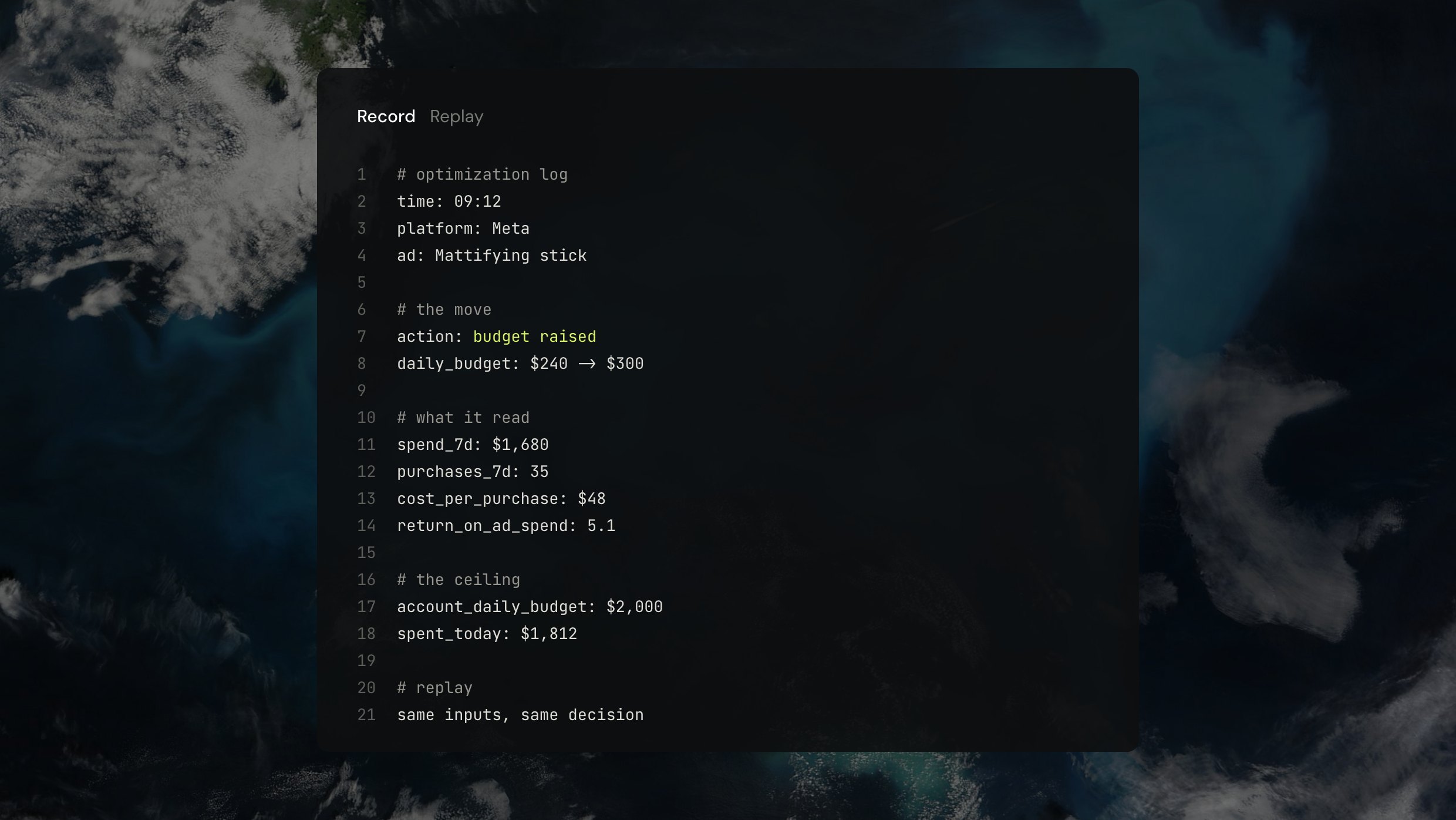
Determinism and a log
Less automation is not the answer. Continuous management beats a Tuesday review, and no brand running real budget is going back to managing ad sets by hand. What is open is which system moves the money, and what it can account for afterwards.
Two properties settle that. The first is determinism: run the same campaign on the same data twice and get the same decisions. That does not make a decision right. It makes it stable, something that can be pointed at, run again and questioned.
The second is a decision log. Every decision is recorded with the data behind it, so you can return to a budget move and see what the system saw when it acted.
A log on its own is a logging feature, and any competent data team can build one. What decides whether a decision can be rebuilt is where it was made from. Google's help pages describe modeled conversions as estimates of conversions it cannot observe directly15.
A decision taken on an estimate cannot be rebuilt past the estimate, because the figure it turned on was never observed. A decision taken on the advertiser's own record of the click and the sale can be. Determinism and a trail follow from deciding on data you hold, not from features bolted on top.
What stays the platform's
You cannot make the ad auction deterministic. Delivery is a system you do not own, and it will stay that way. Anyone promising to make Meta's or Google's internals reproducible is selling something.
What can be made deterministic is the deciding layer: what gets told to the platform, how much, and when. That is narrower than total transparency, and it is the part the CFO was asking about. The question was never why the auction cleared at that price. It was why we moved the money.
Against the three costs, the accounting is uneven. Defending the spend, it answers in full. Learning from a win and diagnosing a loss, it answers up to your own decisions. You see every input you controlled and why you changed it. How the auction responded stays the platform's.
The money moves
New automation often arrives switched on2, and the campaign types that decide the most attract the most budget. The reporting of the last two years, generous as it is, describes outcomes. None of it is a trail of decisions.
Automation is going to move the money either way. What is still open, and worth settling now, is whether a system that moves it can account for the move.