
Meta would rather you did not tell it who your customer is. In its newest campaigns, the audience you set is mostly treated as a suggestion.
Mark Zuckerberg said in May 2025 that Meta now discourages businesses from trying to limit the targeting1. His reason: Meta is "just better at finding the people who are going to resonate with your product than you are."
The new default
The controls are narrowing without disappearing. Meta is discontinuing some detailed targeting options2 in Ads Manager, and merging some of the interest options that remain.
Meta's setup page for Advantage+ campaigns says most audience settings are suggestions3. Manual settings are still there for an advertiser who wants to limit reach. What has moved is the default.
On its July 2026 earnings call, Meta said it now uses large language models to predict the best ad for each person4.
On Google Search, an ad is still matched on how close your keywords are to what the person searched5. Google's newest Search layer, AI Max, reaches past the keywords6, and an advertiser can switch that off in each ad group. On Search, delivery still starts from the advertiser's words. On Meta, the audience has become a suggestion.
What the brief decides
Describing the buyer and instructing delivery were always two jobs, and Meta has taken over much of the second. None of that reaches the decisions a brief makes:
- which markets to open, and in what order
- what the creative and the offer say, and about which product
- what the site and the product range assume about the buyer
A targeting model finds the people most likely to respond to what a brand has already built. These three decisions are where a wrong picture of the buyer still costs money, and all three are settled before an auction runs.
The record you hold
A brand with real budgets already holds a description of its buyer, and a good one. The order, the basket and the lifetime value all start on its own site. In most large brands they sit in a warehouse, cut by cohort every week.
Part of that record already has a pipe to Meta, built by Meta. Its Conversions API sends an advertiser's own events, from its server or its CRM, to the systems that optimize ad targeting7.
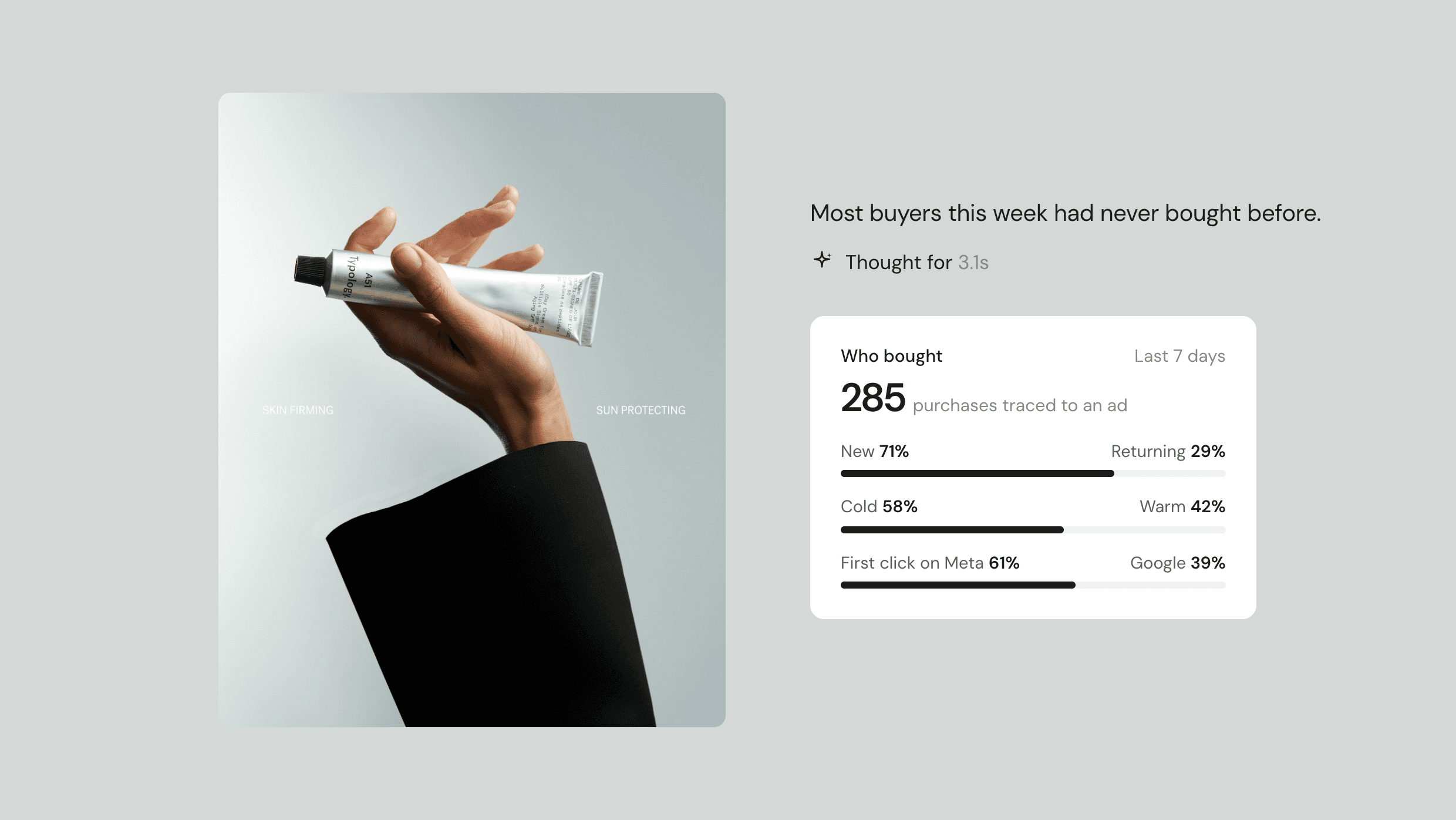
What that record holds is mostly observation: the click ID a visit arrived with, whether it was a return visit, and what ended up in the basket. Whether a click was cold or warm is the brand's own reading of those facts.
There is a price on that input. Four researchers, two of them then at Meta, ran a randomized experiment across more than 70,000 advertisers on Facebook and Instagram. They asked what happens when an advertiser that optimizes on its own purchase data has to optimize on clicks instead.
The median cost of each extra customer would rise by 31%8, from about $38 to about $50. Small advertisers are hurt the most9.
So the record a brand sends has a measured price when it goes. What comes back is a report. Google's audience insights show the traits, interests and behaviors of the people who saw your ads and converted10, with each group's share of conversions. That is the outcome, cut the way the platform cuts it.
Which leaves the same record doing a second job. Read by the brand itself, it is the evidence behind those three decisions: which market, which message, which range. No platform owes anybody that reading.
Buying a description
The other way to get a description of the buyer was to buy one. In 2018 Facebook ended Partner Categories11, the product that let data brokers sell targeting inside its platform. It said the step would help improve people's privacy.
What bought audiences delivered was measured in the same decade, away from Facebook. In one field test, six ad platforms were each asked to reach men in the same age range. On average, about three in five of the impressions reached them12.
The same researchers tested more than 90 audiences from 19 data brokers. They concluded that bought audiences are often not worth their price, except on expensive media.
What P&G did
In 2016, Procter & Gamble's chief brand officer said the company had gone too far into narrow targeting on Facebook13. In his words: "We targeted too much and we went too narrow."
P&G did not stop describing its buyer. By 2018 it was aiming for reach with precision, using its own data on 80% of consumers in markets such as the US and China14. It also worked with retailers that hold purchase patterns, such as Amazon and Alibaba15. It went to better sources of who actually buys.
P&G had done this at brand level before. For Old Spice's The Man Your Man Could Smell Like, its own research found that 60% of men's body washes were bought by women16. The brand broadened its target, and the case calls that dual audience a first for the brand.
Back to the decisions
A model that finds an audience makes none of the three decisions above. A weekly cohort cut answers them about last quarter. The same record, read click by click as it arrives, answers them about the money being spent today.
Those three stay on the brand's side of the fence. So does the record that should settle them: who paid, what brought them, and what they bought.